Welcome: Glassmann Materials Technology Company Limited
Language:
 ∷
∷

∷


TEL:
86-18637342378
∷
86-18637342378
In this paper, we summarize the damage of refractory bricks lined in cement rotary kilns and how to improve the performance from these damages. Additionally, influence of waste used in cement production on refractory linings is presented.
2. WEARING MECHANISM OF REFRACTORIES IN A CEMENT ROTARY KILN
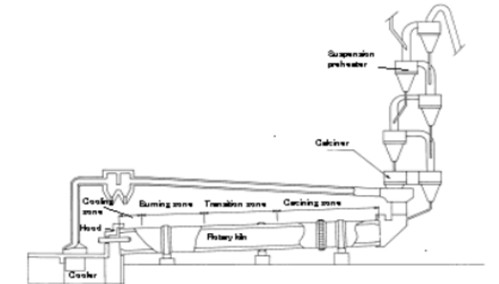
The above photo shows a typical precalciner kiln and its zoning in a rotary kiln. Pulverized cement raw materials are charged from the top of preheater and charged into a rotary kiln after heat-exchanged with combustion gas. In the rotary kiln, raw materials react with each other under high temperature conditions and forms cement clinker that is discharged to the cooler.
Cement containing around 65 mass% CaO is a basic material. Basic bricks that show superior chemical stability to cement raw material are used for the high temperature area in the rotary kiln, such as burning zone where the material reaches around 1450℃, transition zone and cooling zone, which are located before and after the burning zone respectively. Temperatures in transition zone and cooling zone are lower than that in burning zone and the amount of formed liquid phase is a little in cement raw material. Accordingly, cement coating frequently repeats sticking or dropping off on the basic bricks in transition zone and cooling zone. On the other hand, cement coating is stably adhered on the basic bricks in burning zone, where the amount of formed liquid phase is sufficient. Thus, atmosphere and thermal conditions vary with the position in a rotary kiln and wearing mechanism of refractory bricks also varies according to the lined position.
Refractory bricks lined in a rotary kiln are worn by the synergistic effect of thermal, chemical and mechanical actions. These stresses are complicated and it is difficult to distinguish the wearing causes in actual conditions. Hereafter, we simplify the wearing mechanism as much as possible for understanding easily.
a.Thermal shock during heating-up and coating off
b.Unstable coating caused by fluctuation of operation and mechanical stress from shell
c.Expose o the flame without coating
d. Infiltration and reaction with foreign elements like SOx,cement Materials
Observed Phenomena
a.Cracking caused by thermal shock
b.Erosion of bricks
c.Cracking caused by structural change
Countermeasures
Kiln Operation:
a.slow heating-up schedule
B.stable operation
Brick Properties:
1.Increase flexibility to deter crack propagation
2.Increase resistance to thermal load
3.Strengthen the bonding
2.1. Wearing Mechanism in Burning Zone
In burning zone, half melted cement raw material firmly sticks on basic bricks is called coating. However, once the coating drops off due to alternation of operation and/or stresses from the kiln shell, the bricks are exposed to thermal shock and molten cement raw material. Thermal spalling occurs in the lined bricks. When the cement melts infiltrated into the bricks, the bonding structure is destroyed by the reaction of bricks with the cement melts and reacted area is washed out by rotating materials. Thus, the bricks are worn by erosion. In the meantime, infiltrations of the cement melts and alkali salts fill the pores at the hot face and subsequently densified the brick near the hot face. When the bricks are exposed to temperature fluctuation, structural spalling takes place easily.
2.2. Wearing Mechanism in Transition Zone
In transition zone, surface temperature of bricks fluctuates because the coating repeatedly sticks to and drops off from the bricks. The main cause of the wear of basic bricks in transition zone is deterioration of bonding due to frequent temperature changes. The deterioration takes place easily in magnesia-chrome bricks, because the contained iron oxide is transferred from ferric to ferrous, and vice versa depending on the temperature change caused. It is said that magnesia-spinel bricks demonstrate less deterioration and longer durability in the zone, because they do not contain iron oxides. However, magnesia-spinel bricks consist of multiple components
with different thermal expansion rate. The temperature fluctuation also destroys the bonding between different components and consequently magnesia-spinel bricks are deteriorated gradually around the hot face.
When solid fuel containing high sulfur is used, the atmosphere in transition zone could become reduced locally and rich in SOx. MgO and CaO contained in basic bricks may react with infiltrated SOx, causing MgSO4 and CaSO4 to be formed. Then, the sulfates react with K2SO4 or KCl, forming K2SO4·2CaSO4 and low melting components. These moved to the low temperature side from the hot face. The movement of 2SO4·2CaSO4 could destroy the bonding and causes texture deterioration around the hot face.
Furthermore, when steel plates are used as a joint material for basic bricks, the plates are not oxidized sufficiently and form FeO-FeS eutectic under these conditions. The eutectic is liquefied near the hot face and infiltrates the bricks. This leads to open spaces being generated in the infiltrated areas of steel plates. Cracks begin to form at the edge of the remaining steel plate and spread to the bricks. This phenomenon also wears the bricks.
a.Temperature deviation and mechanical action caused by coating deposit of alkali salts,such as K2SO4 or KCl,change the structure of weaken bonding Mechanical stress caused by fatigued shell ovality,shell runout etc.
b.Utilization of solid fuel:Reducing High SOx atmosphere,as severe SOx infiltration.
c.Joint steel plate loss due to reaction with SOx.
Observed Phenomena
a.Deterioration of bonding
b. Severe spalling caused by structual change,mechanical stress and/or tensile stress caused by joint plate.
Countermeasures
Kiln Opertaion: 1.Exchange kiln shell 2.Lower Shell Ovality
Brick Properties:
1.Strengthen the bonding
2. Maintain the flexibility to prevent the crack
3.Lower the porosity to minimize the infiltration of foreign materials
4.Introduce proper thick steel plate
3. APPEARANCES OF USED BRICKS CAUSED BY DIFFERENT WEARING CAUSES AND THEIR COUNTERMEASURES
3.1. Wearing Caused by Thermal Shock
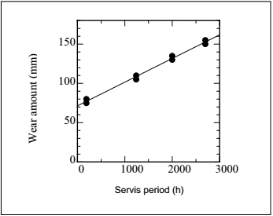
Relationship between service period and wear rate of magnesia chrome brick used in burning zone
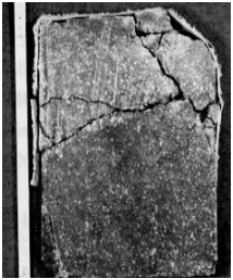
Cracked magnesia chrome bricks by rapid heating-up
The above data shows the relationship between the service period and the wear amount of magnesia-chrome bricks in burning zone. The wear progresses with the service period, of which wear rate is about 50mm/1000h in above data, but the graph presents the linear line does not start from the zero point, that is, approximately 70mm of wearing takes place initially without correlation with service period. The initial wearing is usually around 30mm, but 70mm in above data is quite big. This type of wearing could occur during heating-up after shutdown. Basic bricks in the burning zone are exposed to the direct flame during initial heating-up and cracks may generate by spalling in the brick. Coating is hard to stick on the smooth surface of new bricks and cracks easily generate in new bricks as above data in rapid heating-up schedule. Thus, heating-up plan and starting-up procedure is important for the basic bricks in burning zone to form coating promptly for decelerating wearing.rate of magnesia-chrome brick used in burning zone
Countermeasures
In order to prevent the cracking and spalling at the beginning stage of operation, we think that bricks need to have sufficient flexibility.
3.2. Wearing Caused by Erosion
The wear of basic bricks in burning zone occurs while the coating drops off, because the coating stuck on basic brick protects the brick from thermal shock, chemical reaction with the melt of cement raw material, etc. Erosion by molten cement raw material will occur on the basic bricks sometimes under high thermal load conditions. Appearance of eroded basic bricks is shown in Pht. 1 Appearance of the eroded brick is shown in Fht. 2.

Pht.1:Appearance of eroded basic bricks
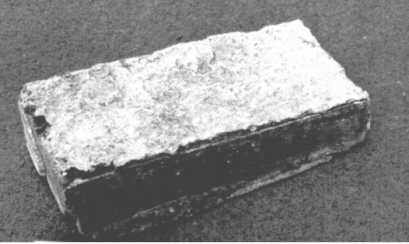
Pht.2:Appearance of eroded basic bricks
Countermeasures
In order to prevent the erosion of basic bricks, it is very important for the bricks to form coating promptly. We studied the mechanism of erosion and developed chrome free Magnesia spinel brick(DF-HA-85A) having good corrosion resistance.
Pht 3 shows the appearance of magnesia-chrome bricks and developed magneisa spinel bricks DF-HA-85A lined in adjacent rings in burning zone. Hot face of magnesia-chrome brick was eroded by the cement liquid phase and the remaining thickness was 120mm. DF-HA-85A bricks, however, showed smooth surface and the remaining thickness was 170mm. According to postmortem analysis, hot face of magnesia-chrome brick became very dense, the cement minerals and reacted minerals were identified in the dense layer. These results indicate the bricks were worn by corrosion. In the DF-HA-85A bricks, the cement minerals and reacted minerals were not identified over the whole region. The bricks could be worn by peeling phenomenon.
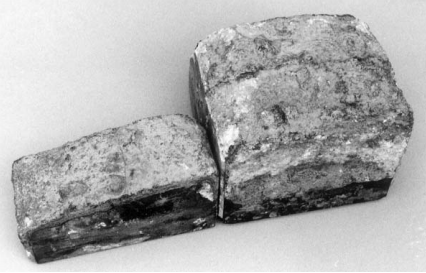
Pht.3:Appearance of used MgO-Cr2O3 brick and DF-HA-85A Bricks
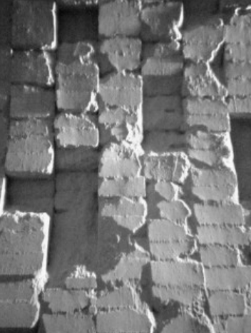
Pht.4:Appearance of transition zone bricks
3.3. Wearing Caused by Spalling
In the transition zone, basic bricks are worn by spalling as Pht.4. The causes of spalling are various, such as mechanical stress caused by shell ovality, joint plate loss, and deterioration of the bonding by the reaction between bricks and sulfur oxides.
Spalling Caused by Mechanical Stress
When the bricks are spalled near the tire area or a retainer ring, the spalling would be caused by the mechanical stress. Some kilns show the cross-sectional deformation of the kiln shell known as ovality near the tire area. As shown in Pht.5, the larger ovality, the shorter service life of the brick lining.The bricks are severely spalled as Pht.4.
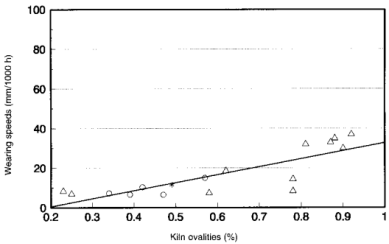
Pht.5:Relation between kiln jovialities and brick wearing speeds
Countermeasures
The maintenance of tire ovality within the acceptable range by replacing filler bars under tire has the positive effect on brick wearing.
Spalling Caused by Joint Steel Plates Loss
2mm thick steel plates are inserted as joint steel plates between basic bricks lined in cement rotary kilns. Joint steel plates are oxidized and bonded to the bricks by the reaction with the brick materials. Then, the individual brick ring becomes one-piece structure and the lateral movement of the bricks as lining displacements will be minimized. Recently, due to the increased use of high sulfur content solid fuels, the atmosphere in the kilns has become locally reducing. Under these conditions and especially when in the presence of sulfur, steel plates are not oxidized sufficiently and form Fe-FeS eutectic. The lowest melting point of Fe-FeS eutectic is 940oC. The eutectic is liquefied and infiltrates into the bricks and leads to open spaces being generated in the filtrated area of steel plates. A cross-section of used bricks taken from transition zone is shown in Fht. 6. Cracks begin to form at the edge of remaining steel plate by the shear stress and spread to the bricks. Then, the brick life is shortened by spalling.
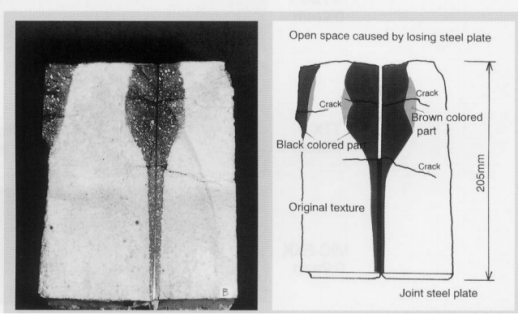
Pht.6:Cross sections of Magnesia Spinel bricks infiltrating joint steel plate
Countermeasures
We could prevent cracking caused by this phenomenon by introducing thin joint steel plates. The use of thin plates does not cause cracking when the plate is lost, because of the less opening between the bricks.
Spalling Caused by Deterioration of the Bonding
Brick texture deteriorated near the hot face and cracks were generated below the deteriorated layer. Densification was observed from the crack to the shell side. PbS that had to be exposed under the reducing atmosphere was identified in the dense layer. K2SO42CaSO4 and KCl were identified in the dense layer. Hot modulus of rupture at 1200℃ of specimen obtained from the different position.
So as to prevent the deterioration, minimize the infiltration of foreign materials by lower the porosity. Then, bonding strength is strengthened to resist the deterioration. However, flexibility of the brick is from the hot face was measured. All specimens showed lower HMOR value than the original. HMOR value at 0-120mm from the hot face were noticeably lowered.
4. INFLUENCE OF WASTE USE ON REFRACTORY LININGS
In cement industry, the use of waste has increased recently. At present, approximately 27 million tpa is employed in kilns as raw material or fuel. The greater utilization of waste, the more adverse effects are on lined refractories. These effects may be attributed to the change of heat balance and an increase in chloride and/or sulfate. The advantages of using waste in the cement industry include:
• High temperature kiln burning rapidly composing waste, while the remaining compounds are absorbed into the cement. Therefore, cement production has a large capability to render even hazardous waste harmless.
• Large amounts of waste can be treated.
• Use of waste can result in cost savings.
5. CONCLUSION
The damages of refractory bricks lined in cement rotary kilns and the countermeasures of each damage are discussed. Further investigations on the brick wearing and its countermeasures in a rotary cement kiln are still underway to continually improve the performance.
Contact: Michael Mann
Phone: 86-18637342378
Tel: 86-18637342378
Email: michaelmann@glassmann.cn
Add: 3U Shuangchuang Room 2033,Yabao Dongfang International Plaza,Zhengdong District,Zhengzhou City, Henan Province,China
 Michael Mann
 Michael Mann